AI vs Traditional Solar Plant Monitoring: Which Is Better for Your Solar Investment?
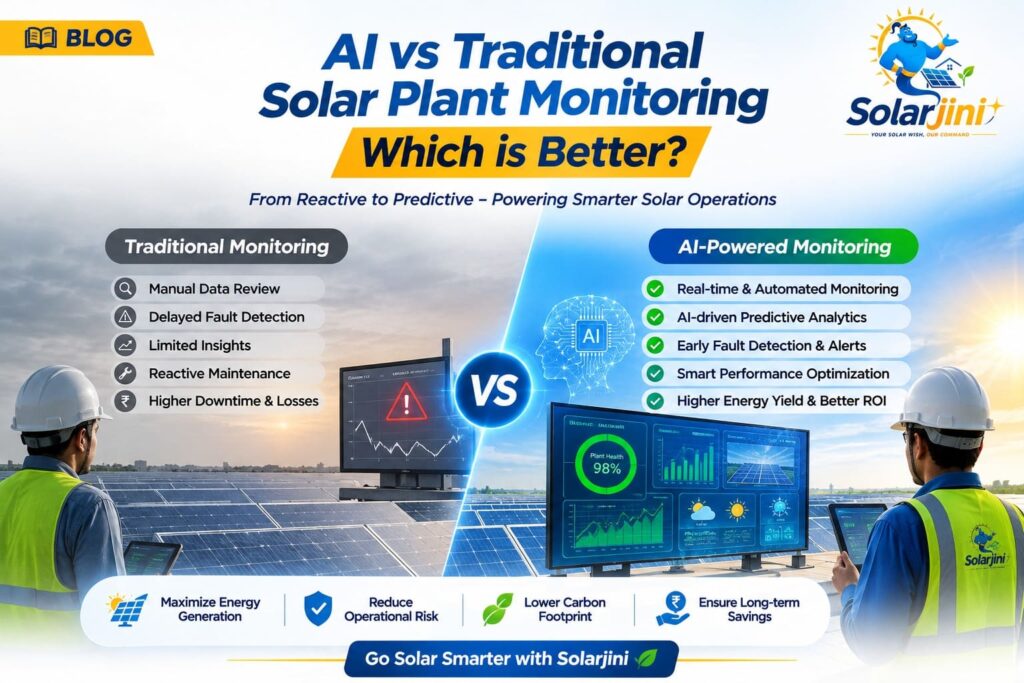
From Reactive Monitoring to Predictive Solar Management Solar power plants are designed to generate clean energy for decades. But installing solar panels is only thebeginning. To achieve maximum energy generation, maintain equipment health, minimize downtime, andprotect long-term returns, effective monitoring and maintenance are equally important. Traditionally, solar plants have relied on scheduled inspections, manual data analysis, and periodicmaintenance. While this approach can work for smaller installations, the growing size and complexity ofcommercial and industrial solar projects are making intelligent monitoring increasingly important. This is where AI-powered solar plant monitoring is changing the way solar assets are operated. Instead of simply telling you what happened, AI-based monitoring can help identify what is happening,why it is happening, and what could happen next. So, which approach is better—traditional monitoring or AI-powered monitoring? Let’s compare. Understanding Traditional Solar Plant Monitoring Traditional solar monitoring typically combines basic monitoring software, periodic inspections, preventivemaintenance schedules, and manual performance analysis. Operations and maintenance teams regularly inspect equipment and review plant performance to identifyfaults or abnormalities. Traditional Monitoring Typically Includes: Advantages of Traditional Monitoring Traditional monitoring still has its place, particularly for smaller solar installations. Lower Initial Investment:Basic monitoring systems generally require less investment in technology and infrastructure. Simple Implementation:Traditional processes are relatively straightforward to deploy and understand. Suitable for Smaller Projects:Residential rooftops and smaller commercial systems may not require sophisticated AI infrastructure. Familiar Maintenance Process:Maintenance teams are generally accustomed to scheduled inspections and manual troubleshooting. However, as a solar plant grows, the limitations of this approach become increasingly visible. The Limitations of Traditional Monitoring A solar plant can contain thousands of modules, multiple inverters, transformers, combiner boxes, sensors,meters, and other critical components. Manually monitoring every component continuously is practically impossible. Traditional monitoring can therefore lead to: A small issue that goes unnoticed today can become a significant generation loss tomorrow. What Is AI-Powered Solar Plant Monitoring? AI-powered solar monitoring combines Artificial Intelligence, Machine Learning, IoT, cloud platforms,data analytics, and real-time monitoring to continuously evaluate solar plant performance. Instead of waiting for a failure, intelligent systems analyze operational patterns and identify abnormalbehavior at an early stage. AI-based monitoring can analyze information from: The objective is simple: Detect problems earlier. Make better decisions. Reduce losses. Improve plant performance. AI vs Traditional Solar Monitoring Parameter Traditional Monitoring AI-Powered Monitoring Fault Detection Reactive Predictive Data Analysis Manual Automated Monitoring Periodic Continuous Maintenance Schedule-Based Condition-Based Alerts Limited/Delayed Real-Time Data Processing Manual AI-Driven Downtime Higher Risk Reduced Energy Optimization Limited Advanced Scalability Limited High Decision Making Human-Driven Data-Driven The biggest difference is the shift from reactive operations to predictive operations. 5 Ways AI Can Improve Solar Plant Operations One of the biggest advantages of AI is predictive maintenance. Traditional maintenance often follows a fixed schedule. Components may be inspected or replaced basedon time intervals rather than their actual condition. AI can analyze historical and real-time performance data to identify unusual patterns. For example, an AI system may identify: This allows maintenance teams to investigate potential problems before they develop into major failures. The result? Less unexpected downtime and more proactive maintenance. Solar plants generate enormous amounts of operational data every day. AI-powered platforms can continuously analyze this data and provide real-time alerts when abnormalconditions are detected. Instead of waiting for a scheduled inspection, operators can receive notifications about potential problemsas they occur. This can significantly reduce the time between: Fault → Detection → Diagnosis → Action Faster response can mean fewer energy losses. A solar plant may lose generation because of issues that are not immediately visible. Examples include: AI can identify deviations from expected performance and help operators understand where generationlosses may be occurring. By identifying these issues earlier, operators can take corrective action and work toward maintainingoptimal plant performance. AI does not simply help identify faults—it can help maintenance teams prioritize them. Instead of treating every issue with the same urgency, intelligent monitoring can help determine: Which problem needs immediate attention? Which issue can be monitored? Which equipment requires preventive maintenance? This can help optimize: Over time, better maintenance planning can contribute to lower operational costs. Solar plant owners and operators need more than a simple generation number. They need visibility into the health and performance of their entire solar asset. AI-powered dashboards can help provide insights into: This transforms solar monitoring from data collection into actionable intelligence. Does AI Replace Human Engineers? No. AI should be viewed as a powerful tool that supports engineering and O&M teams—not as a completereplacement for them. AI can continuously analyze large volumes of data, identify anomalies, and prioritize potential problems.Human engineers can then investigate the issue, validate the findings, and perform the necessarycorrective action. The strongest model is therefore: AI Intelligence + Human Expertise = Smarter Solar O&M When Is Traditional Monitoring Still Enough? AI monitoring is not necessarily required for every solar installation. Traditional monitoring can remain practical for: For smaller systems, the additional investment in advanced analytics may not always provide sufficienteconomic benefit. However, the equation changes as the plant becomes larger and more complex. Why Industrial & Utility-Scale Solar Plants Need Smarter Monitoring Large solar plants generate massive amounts of data every day. Imagine trying to manually analyze thousands of data points from: Modules + Strings + Inverters + Transformers + Weather Stations + Meters + SCADA This is where AI can provide a significant advantage. AI systems can process large datasets continuously and identify patterns that may be difficult to detect through manual analysis. For commercial, industrial, and utility-scale projects, this can translate into: The Future of Solar Monitoring Is Predictive Solar O&M is moving toward a more connected and intelligent ecosystem. The future of solar asset management will increasingly involve technologies such as: Artificial Intelligence For intelligent analysis and anomaly detection. Machine Learning For identifying patterns and predicting potential failures. IoT Sensors For collecting real-time equipment and environmental data. Drone & Thermal Inspections For identifying module-level defects and physical abnormalities. Digital Twins For creating intelligent digital representations of physical solar assets. Advanced Analytics For understanding plant performance and optimizing
Battery Energy Storage Systems (BESS): The Future of Industrial Solar
Introduction Solar energy has transformed the way industries think about electricity. Businesses are increasinglyinstalling rooftop and ground-mounted solar systems to reduce electricity costs, improve energyindependence, and meet sustainability goals. But solar generation has one fundamental limitation: the sun does not shine all day. Industrial facilities, meanwhile, often need electricity during evenings, peak-demand periods, productionshifts, and unexpected grid interruptions. This is where Battery Energy Storage Systems (BESS) become apowerful complement to solar power. A BESS allows businesses to store electricity when it is available and use it when it is most valuable. Insteadof simply generating solar electricity, industries can move toward controllable, flexible and intelligentenergy management. India is also rapidly moving toward a storage-driven renewable-energy ecosystem. The Ministry of New andRenewable Energy (MNRE) highlights energy storage as an important tool for peak shifting, renewableintegration, grid stability, reducing peak deficits and enabling greater use of renewable energy. What Is a Battery Energy Storage System? A Battery Energy Storage System (BESS) is an integrated system that stores electrical energy in batteriesand releases it when required. A typical BESS installation includes: When combined with solar, the system can follow a simple operating cycle: Solar Generation → Battery Charging → Energy Storage → Intelligent Discharge → Industrial Loads For example, surplus solar electricity generated during the afternoon can be stored in the battery anddischarged later when solar generation decreases or electricity demand increases. Why Is BESS Important for Industrial Solar? Installing solar panels alone can significantly reduce daytime grid consumption. However, industrialelectricity consumption does not always match solar generation. A factory may generate its maximum solar power around noon while experiencing its highest electricitydemand later in the afternoon or evening. This creates an energy timing gap. BESS helps bridge that gap. Instead of allowing excess solar generation to go unused, an appropriately designed storage system cancapture that energy and make it available when the facility needs it. This creates a more flexible energy system: Generate → Store → Shift → Use Where Can Industrial BESS Be Used? BESS can be designed for a wide range of commercial and industrial applications. ManufacturingFactories can use BESS for peak shaving, solar energy shifting, backup support and demand management. Warehouses & LogisticsLarge warehouses often have significant daytime and evening loads. Storage can help optimize solarutilization and manage peak demand. Cold StorageCold-storage facilities require reliable electricity around the clock. Solar + BESS can help support criticalrefrigeration loads. Commercial BuildingsShopping centres, office campuses, hotels and large commercial complexes can combine rooftop solar withBESS to optimize electricity consumption. Data Centres & IT FacilitiesHigh-reliability applications can use advanced energy storage as part of their broader power-resiliencearchitecture. Industrial ParksCentralized BESS solutions can support larger electrical networks and help manage changing load patterns. How Does a Solar + BESS System Work? A typical industrial architecture can be represented as: Solar PV System↓Energy Management System↓Power Conversion System (PCS)↓Battery Energy Storage System↓Industrial Loads / Grid The EMS acts as the intelligence layer. It can determine when to: ● Charge the battery● Discharge the battery● Prioritize solar● Draw power from the grid● Maintain backup reserves● Limit peak demand● Respond to changing energy conditions This makes BESS more than a battery. It becomes part of an intelligent energy management platform. Safety: A Critical Part of BESS Design As BESS deployments grow, safety and system engineering become increasingly important. Modern BESS projects need appropriate provisions for battery monitoring, thermal management, electricalprotection, hazard detection, fire safety, emergency shutdown and secure site operation. India’s Central Electricity Authority has introduced updated safety regulations for BESS installations in 2026,alongside technical standards and fire-safety initiatives. Therefore, industrial customers should evaluate more than battery capacity when selecting a BESS solution. Important considerations include: Safety should be engineered into the project from day one. How Should Industries Size a BESS? There is no universal BESS size for every industrial facility. The correct system depends on the facility’s actual energy profile. A professional assessment should consider: Load ProfileUnderstand how much electricity the facility consumes throughout the day. Solar GenerationDetermine how much solar energy is available and when surplus generation occurs. Peak DemandIdentify when maximum demand occurs and how much demand needs to be managed. Tariff StructureEvaluate energy charges, demand charges and time-of-day pricing where applicable. Backup RequirementDetermine which loads require backup and for how long. Battery DurationA system may be designed around different storage durations depending on the application’s objective. Future ExpansionThe system should ideally allow additional storage capacity as energy requirements grow. The Business Case for BESS The economics of BESS should not be evaluated only by looking at the battery’s purchase price. The business case can include multiple value streams: Solar Energy Utilization The actual financial outcome depends on factors such as battery cost, electricity tariff, load profile, solargeneration, operating strategy, battery degradation, financing and project lifetime. Recent research into Indian solar-plus-storage economics also highlights the importance of storageduration, capital cost and operating assumptions when evaluating project viability. Therefore, every industrial BESS project should begin with a site-specific techno-economic assessmentrather than a generic payback calculation. The Future: Solar + Storage + Intelligence The next generation of industrial energy systems will not be based on solar panels alone. The emerging model is: Solar + BESS + EMS + Smart Monitoring Solar provides clean generation. BESS provides flexibility. EMS provides intelligence. Monitoring provides visibility and control. Together, these technologies can transform an industrial facility into a more efficient, resilient andresponsive energy consumer. India’s continued growth in renewable energy is expected to increase the importance of storage.Government projections indicate a substantial requirement for BESS capacity as the country’s renewable-energy penetration grows. Solarjini: Building Smarter Solar Energy Solutions At Solarjini, we believe the future of solar is not simply about installing more panels. It is about creating smarter energy systems. From solar installation and procurement to subsidy assistance, financing, support and maintenance,Solarjini works toward providing an end-to-end solar experience. As energy storage becomes increasingly important for commercial and industrial customers, Solarjini canhelp businesses evaluate the opportunity for Solar + BESS based on their energy consumption, operationalrequirements and long-term sustainability
Understanding Solar Payback Periods for Industrial Projects
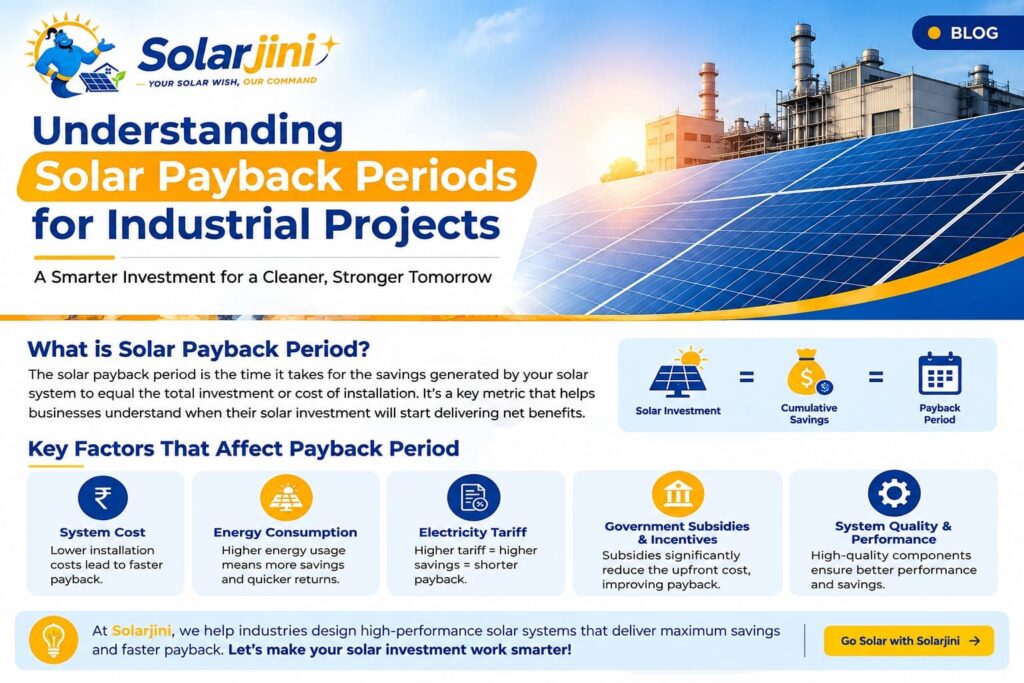
A Smarter Investment for a Cleaner, Stronger Tomorrow Understanding Solar Payback Periods for Industrial Projects For industries, electricity is one of the most significant operating expenses. As electricity tariffs continue to impact business margins, more industrial organizations are turning toward solar energy to reduce long-term energy costs. But before investing in a solar project, one question is critical: “How long will it take for my solar investment to pay for itself?” This is where the solar payback period becomes an important financial metric. What Is the Solar Payback Period? The solar payback period is the amount of time required for the cumulative savings generated by a solar power system to equal the initial investment. In simple terms: Solar Investment ÷ Annual Solar Savings = Approximate Payback Period For example, if an industrial solar installation costs ₹50