From Reactive Monitoring to Predictive Solar Management
Solar power plants are designed to generate clean energy for decades. But installing solar panels is only the
beginning. To achieve maximum energy generation, maintain equipment health, minimize downtime, and
protect long-term returns, effective monitoring and maintenance are equally important.
Traditionally, solar plants have relied on scheduled inspections, manual data analysis, and periodic
maintenance. While this approach can work for smaller installations, the growing size and complexity of
commercial and industrial solar projects are making intelligent monitoring increasingly important.
This is where AI-powered solar plant monitoring is changing the way solar assets are operated.
Instead of simply telling you what happened, AI-based monitoring can help identify what is happening,
why it is happening, and what could happen next.
So, which approach is better—traditional monitoring or AI-powered monitoring?
Let’s compare.
Understanding Traditional Solar Plant Monitoring
Traditional solar monitoring typically combines basic monitoring software, periodic inspections, preventive
maintenance schedules, and manual performance analysis.
Operations and maintenance teams regularly inspect equipment and review plant performance to identify
faults or abnormalities.
Traditional Monitoring Typically Includes:
- Scheduled preventive maintenance
- Manual performance analysis
- Periodic physical inspections
- Basic generation monitoring
- Manual fault identification
- Periodic reporting
- Reactive troubleshooting
Advantages of Traditional Monitoring
Traditional monitoring still has its place, particularly for smaller solar installations.
Lower Initial Investment:
Basic monitoring systems generally require less investment in technology and infrastructure.
Simple Implementation:
Traditional processes are relatively straightforward to deploy and understand.
Suitable for Smaller Projects:
Residential rooftops and smaller commercial systems may not require sophisticated AI infrastructure.
Familiar Maintenance Process:
Maintenance teams are generally accustomed to scheduled inspections and manual troubleshooting.
However, as a solar plant grows, the limitations of this approach become increasingly visible.
The Limitations of Traditional Monitoring
A solar plant can contain thousands of modules, multiple inverters, transformers, combiner boxes, sensors,
meters, and other critical components.
Manually monitoring every component continuously is practically impossible.
Traditional monitoring can therefore lead to:
- Delayed fault detection
- Higher manpower requirements
- Human errors
- Reactive maintenance
- Increased downtime
- Missed performance anomalies
- Energy generation losses
- Difficulty processing large volumes of data
A small issue that goes unnoticed today can become a significant generation loss tomorrow.
What Is AI-Powered Solar Plant Monitoring?
AI-powered solar monitoring combines Artificial Intelligence, Machine Learning, IoT, cloud platforms,
data analytics, and real-time monitoring to continuously evaluate solar plant performance.
Instead of waiting for a failure, intelligent systems analyze operational patterns and identify abnormal
behavior at an early stage.
AI-based monitoring can analyze information from:
- Solar modules
- Inverters
- String-level generation
- Combiner boxes
- Transformers
- Weather stations
- SCADA systems
- Energy meters
- IoT sensors
- Battery Energy Storage Systems (BESS)
The objective is simple:
Detect problems earlier. Make better decisions. Reduce losses. Improve plant performance.
AI vs Traditional Solar Monitoring
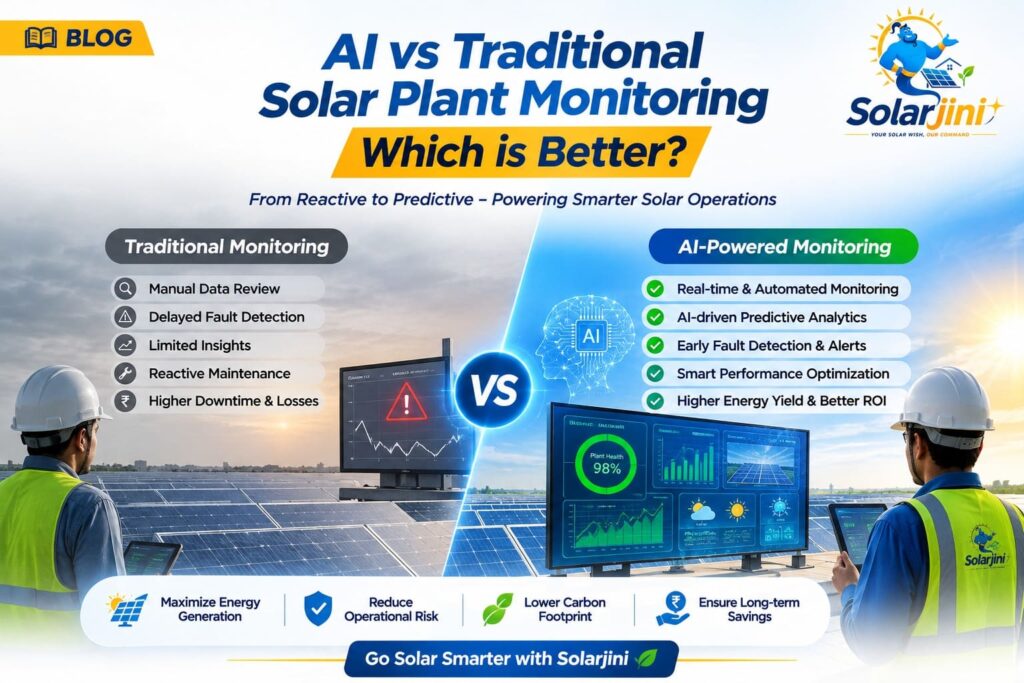
| Parameter | Traditional Monitoring | AI-Powered Monitoring |
|---|---|---|
| Fault Detection | Reactive | Predictive |
| Data Analysis | Manual | Automated |
| Monitoring | Periodic | Continuous |
| Maintenance | Schedule-Based | Condition-Based |
| Alerts | Limited/Delayed | Real-Time |
| Data Processing | Manual | AI-Driven |
| Downtime | Higher Risk | Reduced |
| Energy Optimization | Limited | Advanced |
| Scalability | Limited | High |
| Decision Making | Human-Driven | Data-Driven |
The biggest difference is the shift from reactive operations to predictive operations.
5 Ways AI Can Improve Solar Plant Operations
- Predictive Maintenance
One of the biggest advantages of AI is predictive maintenance.
Traditional maintenance often follows a fixed schedule. Components may be inspected or replaced based
on time intervals rather than their actual condition.
AI can analyze historical and real-time performance data to identify unusual patterns.
For example, an AI system may identify:
- Abnormal inverter performance
- Declining string output
- Unexpected temperature variations
- Module degradation
- Repeated equipment anomalies
This allows maintenance teams to investigate potential problems before they develop into major failures.
The result? Less unexpected downtime and more proactive maintenance.
- Real-Time Monitoring and Alerts
Solar plants generate enormous amounts of operational data every day.
AI-powered platforms can continuously analyze this data and provide real-time alerts when abnormal
conditions are detected.
Instead of waiting for a scheduled inspection, operators can receive notifications about potential problems
as they occur.
This can significantly reduce the time between:
Fault → Detection → Diagnosis → Action
Faster response can mean fewer energy losses.
- Improved Energy Generation
A solar plant may lose generation because of issues that are not immediately visible.
Examples include:
- Dirty modules
- String mismatch
- Shading
- Inverter inefficiency
- Module degradation
- Hotspots
- Equipment abnormalities
AI can identify deviations from expected performance and help operators understand where generation
losses may be occurring.
By identifying these issues earlier, operators can take corrective action and work toward maintaining
optimal plant performance.
- Reduced Operational & Maintenance Costs
AI does not simply help identify faults—it can help maintenance teams prioritize them.
Instead of treating every issue with the same urgency, intelligent monitoring can help determine:
Which problem needs immediate attention?
Which issue can be monitored?
Which equipment requires preventive maintenance?
This can help optimize:
- Workforce utilization
- Spare parts planning
- Maintenance schedules
- Emergency repairs
- Inspection efforts
- Equipment replacement decisions
Over time, better maintenance planning can contribute to lower operational costs.
- Better Decision Making Through Data
Solar plant owners and operators need more than a simple generation number.
They need visibility into the health and performance of their entire solar asset.
AI-powered dashboards can help provide insights into:
- Plant performance
- Equipment health
- Generation trends
- Performance deviations
- Energy losses
- Maintenance priorities
- Equipment behavior
- Historical trends
- Operational efficiency
This transforms solar monitoring from data collection into actionable intelligence.
Does AI Replace Human Engineers?
No.
AI should be viewed as a powerful tool that supports engineering and O&M teams—not as a complete
replacement for them.
AI can continuously analyze large volumes of data, identify anomalies, and prioritize potential problems.
Human engineers can then investigate the issue, validate the findings, and perform the necessary
corrective action.
The strongest model is therefore:
AI Intelligence + Human Expertise = Smarter Solar O&M
When Is Traditional Monitoring Still Enough?
AI monitoring is not necessarily required for every solar installation.
Traditional monitoring can remain practical for:
- Residential rooftop systems
- Small commercial installations
- Low-capacity solar projects
- Budget-sensitive projects
- Systems with limited monitoring infrastructure
For smaller systems, the additional investment in advanced analytics may not always provide sufficient
economic benefit.
However, the equation changes as the plant becomes larger and more complex.
Why Industrial & Utility-Scale Solar Plants Need Smarter Monitoring
Large solar plants generate massive amounts of data every day.
Imagine trying to manually analyze thousands of data points from:
Modules + Strings + Inverters + Transformers + Weather Stations + Meters + SCADA
This is where AI can provide a significant advantage.
AI systems can process large datasets continuously and identify patterns that may be difficult to detect through manual analysis.
For commercial, industrial, and utility-scale projects, this can translate into:
- Faster fault identification
- Reduced downtime
- Improved asset availability
- Better maintenance planning
- Improved energy yield
- Lower operational risk
- Longer equipment life
- Better return on solar investment
The Future of Solar Monitoring Is Predictive
Solar O&M is moving toward a more connected and intelligent ecosystem.
The future of solar asset management will increasingly involve technologies such as:
Artificial Intelligence
For intelligent analysis and anomaly detection.
Machine Learning
For identifying patterns and predicting potential failures.
IoT Sensors
For collecting real-time equipment and environmental data.
Drone & Thermal Inspections
For identifying module-level defects and physical abnormalities.
Digital Twins
For creating intelligent digital representations of physical solar assets.
Advanced Analytics
For understanding plant performance and optimizing energy generation.
The result is a shift from:
“Something failed. Let’s fix it.”
to:
“The data indicates something may fail. Let’s act before it happens.”
AI-Powered Monitoring: An Investment in Solar Performance
The real value of a solar plant is not simply measured by installed capacity.
A 1 MW, 10 MW, or 100 MW plant must consistently deliver its expected generation throughout its
operational life.
Every avoidable fault, every hour of downtime, and every unnoticed performance deviation can impact the
financial return of the project.
That is why intelligent monitoring should be considered more than a technology upgrade.
It is a performance and asset-management strategy.
Why Choose Solarjini?
At Solarjini, our vision is to make solar adoption simpler, smarter, and more reliable—from installation to
long-term operation.
Our end-to-end solar ecosystem is designed around the complete lifecycle of your solar investment,
including:
☀️ Solar Installation
Professional solar project execution focused on reliable and efficient systems.
🛒 Procurement
Helping customers access the right solar products and solutions.
📋 Subsidy Application
Support with applicable solar subsidy processes and documentation.
🛠️ Support & Maintenance
Ongoing technical support and maintenance to keep your solar system performing.
💰 Financing Solutions
Solutions designed to make solar adoption more accessible.
🛡️ End-to-End Service
A complete approach to solar—from planning and installation to long-term support.
With intelligent monitoring and proactive maintenance becoming increasingly important, Solarjini aims to
help customers move toward a smarter approach to solar asset management.
Final Verdict: AI vs Traditional Monitoring
There is no universal answer for every solar project.
For a small rooftop installation, traditional monitoring may be sufficient.
But for commercial, industrial, and utility-scale solar plants, AI-powered monitoring can provide
significant advantages through continuous analysis, predictive maintenance, faster fault detection, and
better performance insights.
The future of solar O&M is moving from:
Reactive → Predictive
Manual → Automated
Periodic → Continuous
Data → Intelligence
Maintenance → Optimization
The question is no longer simply whether your solar plant is generating electricity.
The bigger question is:
Is your solar plant operating at its full potential?
With smarter monitoring, proactive maintenance, and the right solar partner, you can work toward
maximizing energy generation, reducing operational risks, and protecting your long-term solar investment.
Solarjini — Your Solar Wish, Our Command.
Go Solar Smarter with Solarjini.
Website: solarjini.com
Frequently Asked Questions
What is AI-based solar plant monitoring?
AI-based solar monitoring uses artificial intelligence, machine learning, sensors, and data analytics to continuously analyze solar plant performance and identify abnormal conditions.
How does AI help solar plant maintenance?
AI can identify unusual performance patterns and potential equipment problems early, helping maintenance teams move from reactive repairs toward predictive maintenance.
Is traditional monitoring still useful?
Yes. Traditional monitoring can be appropriate for smaller residential and commercial solar systems where advanced monitoring may not be economically necessary.
Can AI increase solar power generation?
AI does not create additional sunlight or panel capacity, but it can help identify performance losses, faults, degradation, and operational inefficiencies earlier so corrective action can be taken.
Is AI monitoring suitable for industrial solar plants?
Yes. Large commercial, industrial, and utility-scale plants can particularly benefit from AI because they generate large amounts of operational data that are difficult to analyze manually.
What is the biggest difference between traditional and AI monitoring?
The biggest difference is reactive versus predictive operation. Traditional monitoring generally identifies problems after they occur, while AI-powered systems can analyze patterns and help identify potential problems earlier.